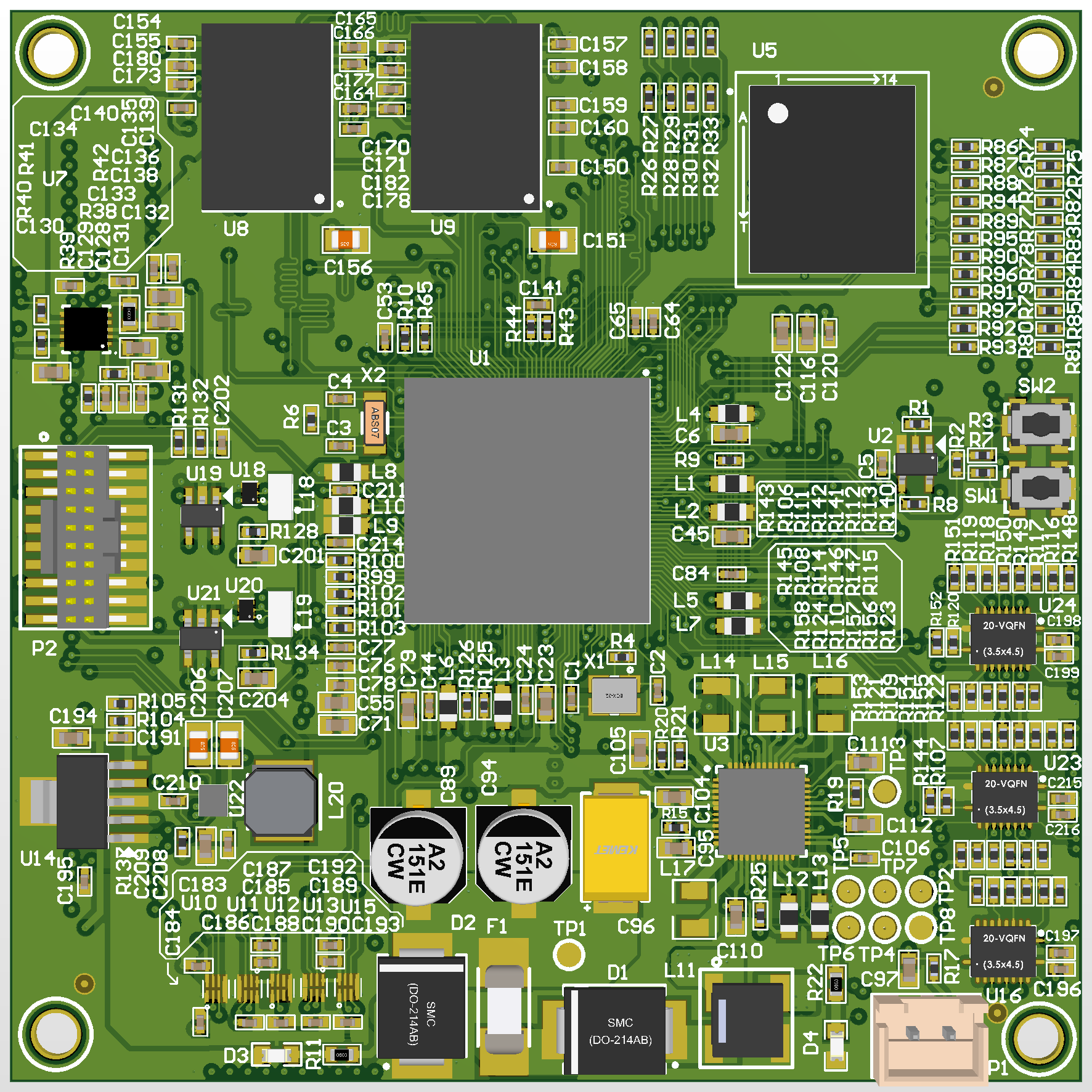
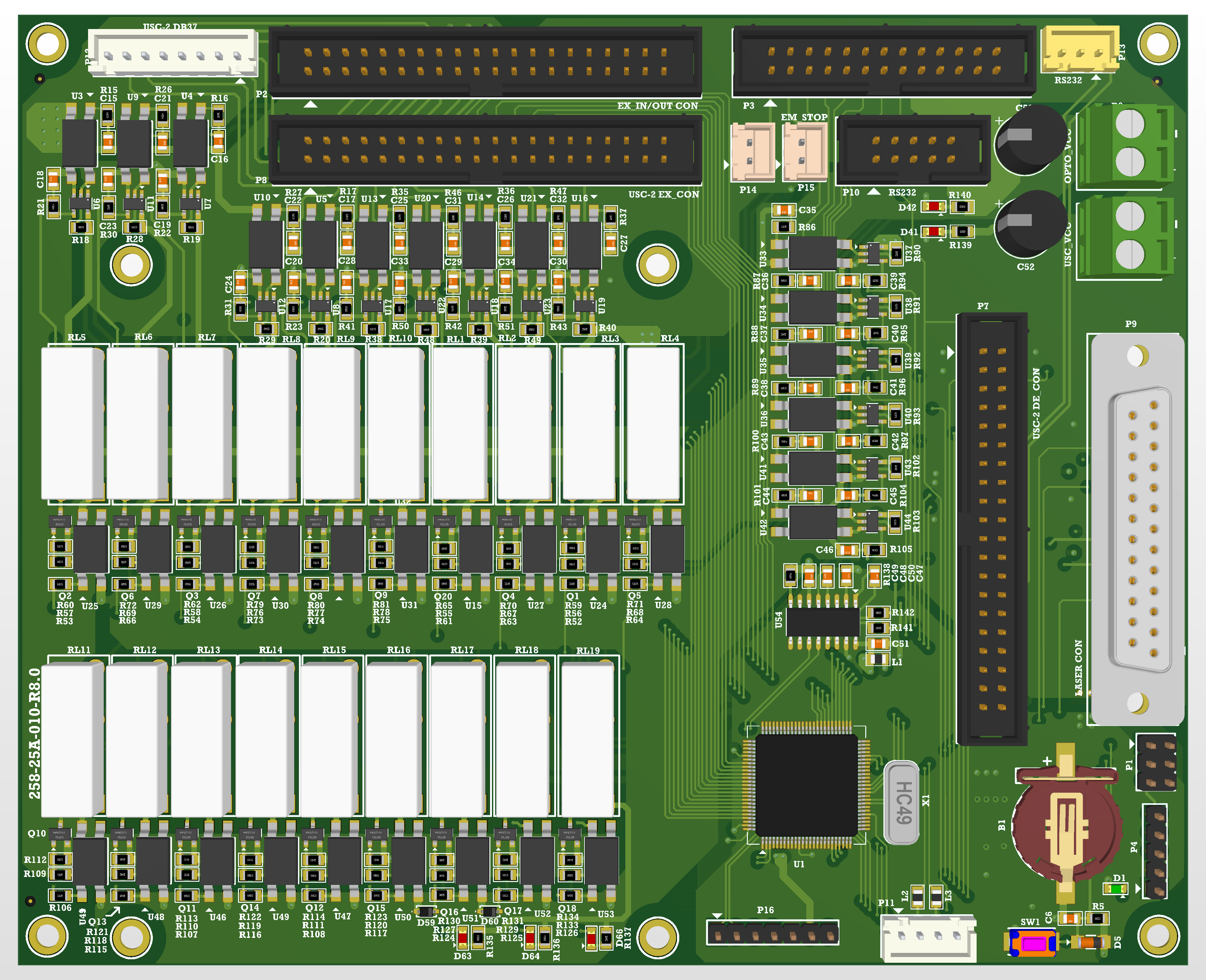
 3D Rendered Board
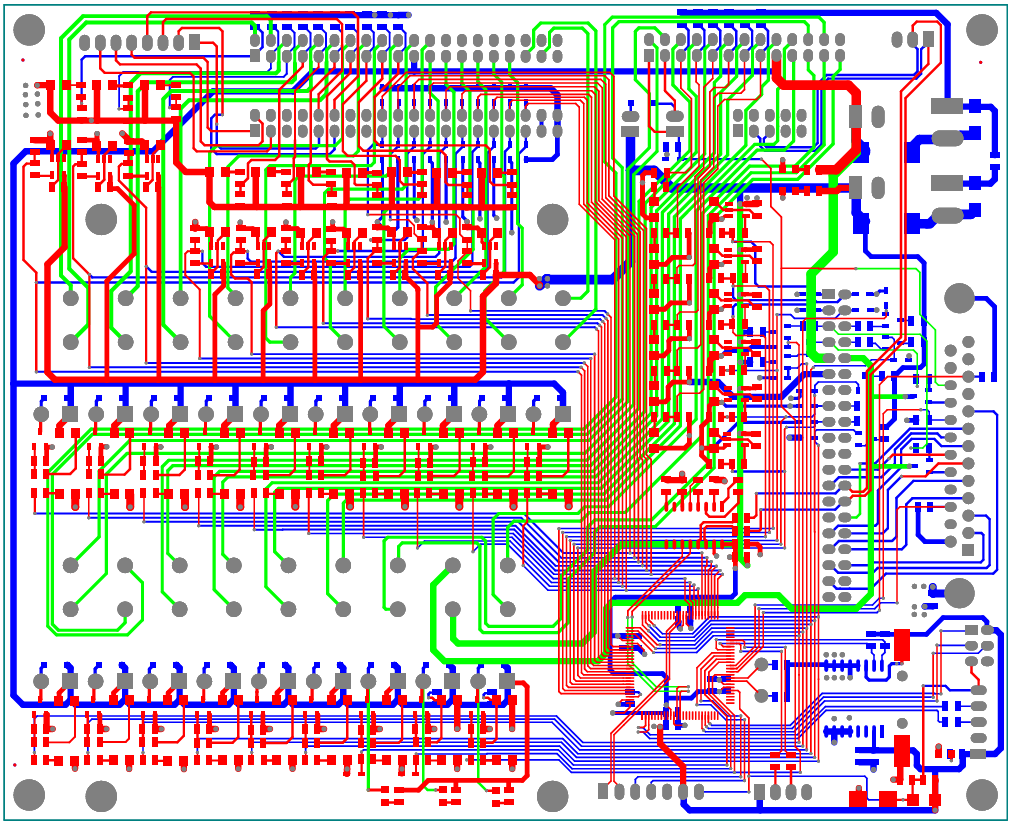 2D Design Layout
Slide to compare the 2D PCB design layout with the 3D rendered board.
Introduction
A 32-bit microcontroller is widely used in automotive electronics for intelligent control, monitoring, and communication functions. In relay control applications, it provides the processing capability required to manage multiple automotive loads, perform real-time decision-making, and ensure reliable operation of electrical systems. By interfacing with sensors, switches, communication networks, and power drivers, the microcontroller can control relays used for lighting, power distribution, HVAC systems, battery management, vehicle accessories, and other automotive subsystems. Its high processing performance, integrated peripherals, and robust communication interfaces make it an ideal solution for modern automotive control modules.
Why a 32-Bit Microcontroller is Suitable for Relay Control
Automotive relay control systems require fast response times, reliable operation, and the ability to manage multiple inputs and outputs simultaneously. A 32-bit microcontroller provides sufficient processing power to monitor vehicle signals, execute control algorithms, and activate relays based on predefined operating conditions. It can process inputs from sensors, switches, CAN networks, and diagnostic systems while ensuring accurate timing and fault detection. Built-in peripherals such as GPIO, timers, PWM modules, ADCs, watchdog timers, and communication interfaces simplify the development of intelligent relay control systems. The microcontroller also supports diagnostic functions, event logging, and communication with other Electronic Control Units (ECUs), enhancing overall vehicle reliability and functionality.
Applications
In automotive electronics, 32-bit microcontrollers are used to control relays for headlights, fog lamps, power windows, door locks, cooling fans, fuel pumps, HVAC systems, battery management units, ignition systems, auxiliary power distribution, and electric vehicle subsystems. The microcontroller continuously monitors input signals and operating conditions, automatically switching relays ON or OFF based on vehicle requirements. It can also implement safety features such as overcurrent protection, fault detection, load monitoring, and diagnostic reporting. These capabilities help improve system reliability, reduce wiring complexity, and support intelligent vehicle operation.
At GVK POWER, we develop custom relay control hardware solutions using 32-bit microcontrollers, including schematic design, multilayer PCB development, power driver circuits, communication interface integration, embedded firmware development, testing, and production support for automotive applications.
At GVK POWER, we develop custom relay control hardware solutions using 32-bit microcontrollers, including schematic design, multilayer PCB development, power driver circuits, communication interface integration, embedded firmware development, testing, and production support for automotive applications.
Hardware Capabilities
A typical 32-bit microcontroller used for automotive relay control integrates high-speed processing cores, GPIOs, timers, PWM modules, ADCs, watchdog timers, Flash memory, SRAM, and multiple communication interfaces such as CAN, LIN, UART, SPI, and I²C. These peripherals enable real-time monitoring of vehicle inputs, relay actuation, fault detection, diagnostics, and communication with other vehicle control modules. The microcontroller can interface with relay driver circuits, sensors, switches, displays, and automotive communication networks, creating a complete and intelligent relay control platform.
Benefits
- Reliable control of multiple automotive relays
- Fast response for real-time vehicle functions
- Supports CAN, LIN, UART, SPI, and I²C communication
- Enables intelligent load management
- Supports fault detection and diagnostics
- Reduces wiring complexity through programmable control
- Improves vehicle safety and reliability
- Low power consumption
- Scalable for various automotive subsystems
- Supports software-based feature upgrades
- Easy integration with sensors and ECUs
- Suitable for both conventional and electric vehicles
Design Considerations
- Select automotive-grade microcontrollers and components.
- Design robust relay driver circuits with adequate current handling capability.
- Implement protection against reverse polarity, overvoltage, and transient conditions.
- Ensure proper grounding and power distribution for stable operation.
- Follow EMI/EMC design practices for automotive environments.
- Include watchdog and fault-monitoring functions for system reliability.
- Optimize PCB layout for signal integrity and thermal performance.
- Provide protection circuits for relay contacts and inductive loads.
- Validate the design under automotive operating conditions.
- Design for manufacturability, testing, and long-term reliability.
Why Choose GVK POWER?
GVK POWER specializes in automotive embedded hardware development, including relay control modules, body control systems, power distribution units, and intelligent vehicle electronics. Our expertise covers hardware architecture, schematic design, multilayer PCB development, embedded firmware, communication interface integration, prototyping, testing, and manufacturing support. We develop reliable and production-ready automotive hardware solutions tailored to customer requirements. With extensive experience in embedded systems and automotive electronics, GVK POWER delivers scalable and high-performance relay control platforms for modern vehicles.